Domestic Toilet Repair: What to Expect
A toilet that runs constantly, won't flush properly, or drips from the cistern isn't something to leave. Left unattended, a faulty fill valve can waste thousands of litres of water, and a slow leak can cause damage to flooring or the ceiling below. Most toilet faults are mechanical and straightforward to put right. This guide explains what you can expect when you book a toilet repair with EPM.
Before Your Appointment
There's very little you need to do before we arrive.
Let us know at booking whether you have an isolation valve on the supply pipe to the cistern. This is usually a small slotted valve on the pipe running into the base of the cistern. If you're not sure, the engineer will check on arrival.
The engineer will need clear access to the toilet and the area around it. If the WC is in a particularly tight or enclosed space, please mention this when booking. If there are any parking restrictions or access instructions, let us know in advance.
What Happens During the Visit
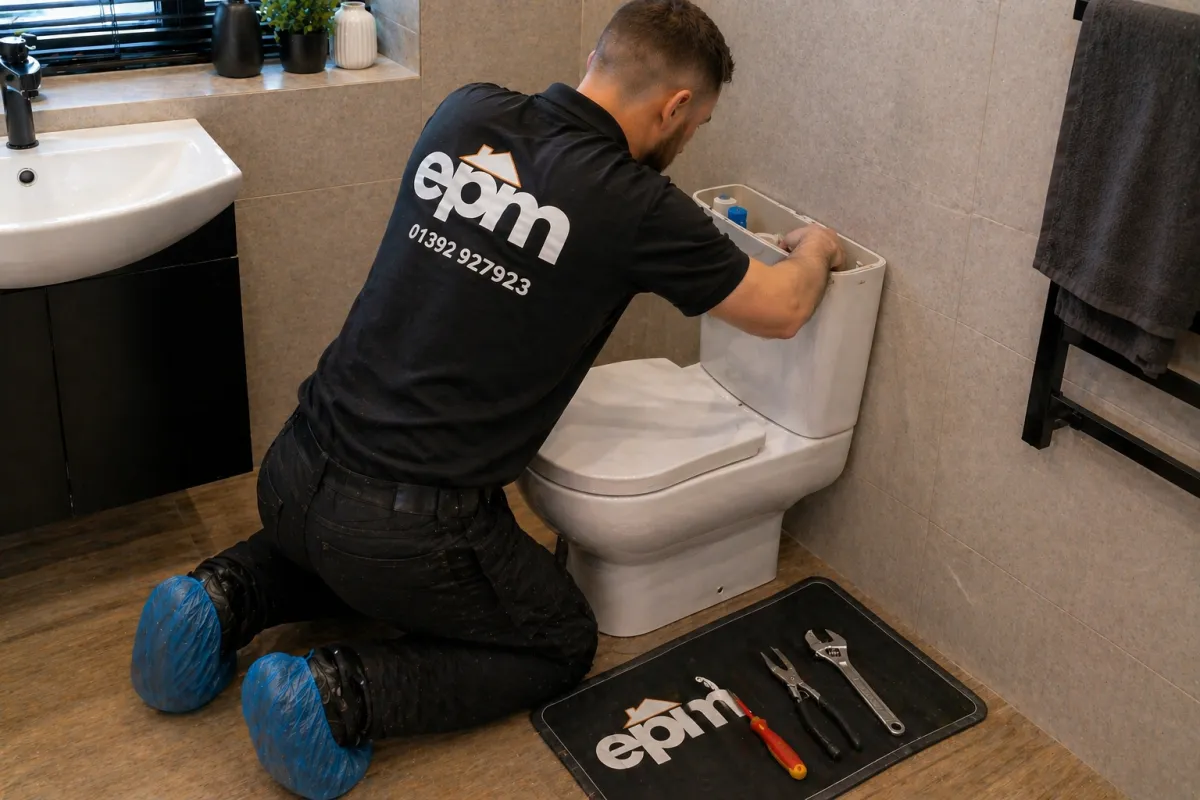
The engineer will begin by assessing the fault. For most toilet repairs this means lifting the cistern lid and inspecting the internal components: the fill valve, flush valve or siphon, the float, and the overflow.
The water supply to the cistern will be isolated before any work begins. Where an isolation valve is fitted and working, only the local supply to that toilet is turned off and the rest of your water supply is unaffected. Where there's no working isolation valve, the mains supply will need to be turned off for a short period. If no isolation valve is present, the engineer will fit one where possible as part of the job.
Faulty components are replaced rather than repaired where parts are available. Common replacements include fill valves, flush valves, siphons, and overflow fittings. If the fault involves a leak at the pan base, the engineer will assess whether this can be addressed in the same visit or whether further work is required.
Minor incidentals such as corroded flexi hoses or worn fittings will be dealt with as part of the job, and you'll be told before the engineer leaves. If anything more significant comes to light, we'll flag it with you before proceeding.
Before leaving, the engineer will make sure the work area is left clean and tidy and answer any questions you may have.
How Long Does It Usually Take
Most toilet repairs take between one and two hours. A straightforward component replacement is usually at the shorter end of that range. If the fault is more involved, for example a pan seal issue or significant corrosion, the visit may run to two or three hours.
Things That Could Affect the Job
- No working isolation valve on the supply pipe, requiring the mains to be turned off
- Corroded or seized internal components that are difficult to remove
- Non-standard cistern fittings that require specific parts not held on the van
- A leak at the pan base or collar that requires additional work beyond the cistern
- Limited access in tight or enclosed bathrooms or WCs
- Older close-coupled or low-level toilets where parts may need to be sourced and a return visit arranged
Frequently Asked Questions
Do I need to be at home during the repair?
No. You just need to arrange access for the engineer. If you're comfortable letting the engineer attend without you present, that works fine.
Will my water supply be disrupted?
If there's a working isolation valve on the supply to the cistern, only the local supply to that toilet is turned off. The rest of your water supply isn't affected. Where no working isolation valve exists, the mains will need to be turned off briefly while the work is carried out.
Can the toilet usually be fixed in one visit?
In most cases, yes. Common components are carried on the van. Where a non-standard part needs to be ordered, a return visit will be required, and you'll be informed on the day.
What happens if the toilet needs replacing rather than repairing?
If the engineer finds that repair isn't practical, they'll discuss this with you before any further work is carried out. Nothing is replaced without your agreement.
Is the toilet out of use while the engineer is working?
Yes, the toilet will be out of use for the duration of the visit. For most repairs this is one to two hours. If you only have one bathroom, it's worth planning around this.
Key Points
Typical appointment: morning or afternoon slot
Engineer required: one
Typical visits: one in most cases, occasionally two if parts need to be sourced
Materials: common components carried on the van; non-standard parts may need ordering
Property disruption: toilet out of use during the visit; water supply disruption limited to the local supply where an isolation valve is in place, or a brief mains interruption where it is not
Access required: to the toilet and surrounding area
